BRAM DEMUNTER
Crowded Valley
21 May - 4 July, 2026
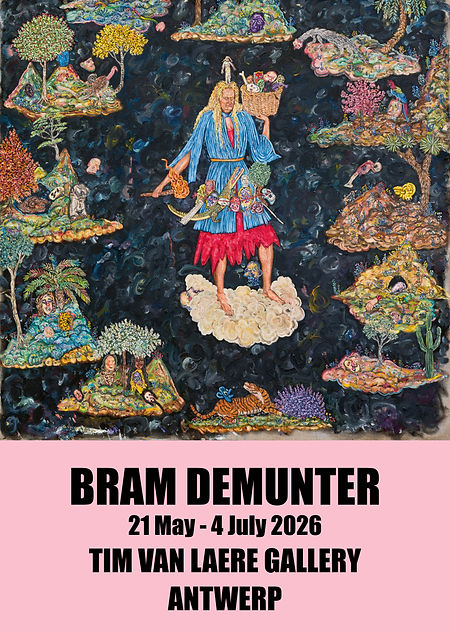
Tim Van Laere Gallery presents Crowded Valley, the fourth solo exhibition by Bram Demunter at the gallery. For this exhibition, Demunter unveils a new series of paintings and watercolor drawings, while introducing bronze sculpture into his practice for the first time. These new works mark a distinct shift within the artist’s oeuvre. Where earlier paintings unfolded as expansive narrative landscapes populated by countless simultaneous scenes, a more concentrated and self-contained visual world now emerges. Central figures - floating heads, hybrid bodies, or solitary travelers moving between islands and mountains - serve as anchor points around which smaller scenes, animals, spirits, and fragments orbit. The compositions adopt a pronounced circular structure, evoking cosmograms, mandalas, or mythological maps.
What gives these works their particular force is their resistance to any singular interpretation. Rather than functioning as linear narratives, they unfold as networks of associations. Fragments appear without fixed hierarchy, references accumulate without explicit explanation. The viewer is invited to forge connections and construct meaning within images that resist definitive reading. In this sense, the paintings operate according to the logic of dreams or myths: coherent yet irrational, structured yet non-linear. A key source of inspiration is the medieval genre of the Immram: mythical sea voyages such as that of Saint Brendan, in which islands are inhabited by wondrous beings and timeless, unchanging scenes. This suspended atmosphere helps explain the silent, stoic gaze carried by many of Demunter’s figures. They appear as archetypes: travelers who are at once hero, hermit, monster, and witness. Echoes of characters such as Dante Alighieri, Odysseus, Gilgamesh, or Dulle Griet can be discerned, even as these figures dissolve into vegetation, earth, and animal forms. In Crowded Valley, the human figure is no longer presented as an autonomous individual, but as a node in which different forms of life converge. Bodies continuously mutate: human becomes animal, plant, or landscape. As such, the paintings do not operate as straightforward stories, but as layered constellations of meaning in which associations accumulate without stable hierarchy. Demunter constructs a visually intertextual world in which everything can coexist simultaneously.
The painting process itself mirrors this continual transformation. Demunter works on multiple canvases at once, repeatedly overpainting sections and allowing compositions to evolve organically. Structure often emerges only retrospectively, as though the image gradually organizes itself from within. He compares this working method to the layered complexity of Tibetan thangkas, Mughal painting, or enclosed late medieval gardens: even within overwhelming visual abundance, a hidden order eventually reveals itself.
Alongside the paintings and watercolors, Demunter presents bronze sculptures for the first time. Finished with patina and oil paint, these works extend the same hybrid and organic visual language into three dimensions. Tree, body, animal, and relic flow seamlessly into one another. The sculptures appear both archaic and animate, like enchanted objects or amulets from an unknown mythology. For Demunter, they function as tangible condensations of the same world evoked in his paintings: fragments of a cosmos temporarily taking material form. Religious and spiritual image traditions play an equally important role. Influences drawn from Christian iconography, saints’ lives, and visionary imagery (including that of Hildegard of Bingen) resonate throughout the exhibition, alongside references to animistic spirits, demonology, and mythologies from diverse cultures. As in much of Demunter’s work, the central figures are often those who withdraw from the world: hermits, seers, travelers, and guardians seeking meaning within a fractured reality. At the same time, contemporary anxieties permeate the imagery. Climate change, war, social upheaval, and existential uncertainty are filtered through ancient stories and symbolic forms. Rather than offering direct answers, Demunter’s work searches for ways to making chaos and complexity perceptible through imagination, ritual, and fiction.
With Crowded Valley, Bram Demunter further deepens his exploration of image-making, mythology, and collective imagination. Together, painting and sculpture form a dense and transformative world in which nothing is ever entirely fixed: a contemporary mythology where human, animal, landscape, and history remain inseparably intertwined.
Tim Van Laere Gallery presenteert Crowded Valley, de vierde solotentoonstelling van Bram Demunter (°1993, Kortrijk) in de galerie. Voor deze tentoonstelling toont Demunter een nieuwe reeks schilderijen en aquarel tekeningen, en introduceert hij voor het eerst bronzen sculpturen binnen zijn praktijk. In deze nieuwe werken tekent zich een duidelijke verschuiving af binnen Demunters oeuvre. Waar eerdere schilderijen zich ontvouwden als uitgestrekte, narratieve landschappen waarin talloze scènes simultaan aanwezig waren, ontstaat nu een meer geconcentreerde en gesloten beeldwereld. Centrale figuren - zwevende hoofden, hybride lichamen of eenzame reizigers tussen eilanden en bergen - functioneren als ankerpunten waaromheen kleinere scènes, dieren, geesten en fragmenten cirkelen. De composities krijgen daarbij een uitgesproken circulaire structuur die doet denken aan kosmogrammen, mandala’s of mythologische kaarten.
Wat deze werken zo krachtig maakt, is hun weigering om zich te laten reduceren tot één betekenislaag. Ze functioneren niet als lineaire vertellingen, maar als netwerken van associaties. Fragmenten verschijnen zonder duidelijke hiërarchie, verwijzingen stapelen zich op zonder expliciete uitleg. De kijker wordt uitgenodigd om zelf verbanden te leggen, om betekenis te construeren in een beeld dat zich niet eenduidig laat lezen. In die zin benaderen deze schilderijen de logica van dromen of mythes: ze zijn coherent, maar niet rationeel; gestructureerd, maar niet lineair. Een belangrijke inspiratiebron vormt het middeleeuwse genre van de Immram: mythische zeereizen zoals die van Sint Brandaan, waarin eilanden bevolkt worden door wonderlijke figuren en eeuwig onveranderlijke taferelen. Die tijdloze sfeer verklaart de verstilde, stoïcijnse blik van veel personages in Demunters werk. Zijn figuren lijken archetypen: reizigers die tegelijk held, kluizenaar, monster en getuige zijn. Ze dragen sporen van personages als Dante, Odysseus, Gilgamesh of Dulle Griet, maar lossen tegelijk op in vegetatie, aarde en dierlijke vormen. In Crowded Valley wordt de mens niet langer voorgesteld als een autonoom individu, maar als een knooppunt waarin verschillende vormen van leven samenkomen. Lichamen muteren voortdurend: mens wordt dier, plant of landschap. De schilderijen functioneren daardoor niet als lineaire vertellingen, maar als netwerken van associaties waarin betekenissen zich opstapelen zonder vaste hiërarchie. Demunter creëert een “visueel intertekstuele” wereld waarin alles naast elkaar kan bestaan.
Ook het schilderproces zelf weerspiegelt die voortdurende transformatie. Demunter werkt simultaan aan meerdere doeken, overschildert voortdurend delen van een werk en laat composities organisch ontstaan. Structuur verschijnt vaak pas achteraf, alsof het beeld zichzelf langzaam organiseert. Hij vergelijkt die werkwijze met de gelaagdheid van Tibetaanse thangka’s, Mughal-schilderkunst of besloten hofjes uit de late middeleeuwen: zelfs in de grootste visuele overdaad ontstaat uiteindelijk een verborgen orde.
Naast schilderijen en aquarellen toont Demunter voor het eerst ook bronzen sculpturen. Deze beelden, afgewerkt met patina en olieverf, zetten dezelfde hybride en organische beeldtaal verder in drie dimensies. Boom, lichaam, dier en reliek vloeien in elkaar over. De sculpturen ogen tegelijk archaïsch en levend, als bezielde objecten of amuletten uit een onbekende mythologie. Voor Demunter functioneren ze als tastbare condensaties van dezelfde wereld die zijn schilderijen oproepen: fragmenten van een kosmos die zich tijdelijk materialiseert. Religieuze en spirituele beeldtradities spelen daarbij een belangrijke rol. Invloeden van christelijke iconografie, heiligenlevens en visioenen (onder meer die van Hildegard van Bingen) resoneren doorheen de tentoonstelling, naast verwijzingen naar animistische geesten, demonologie en mythologie uit uiteenlopende culturen. Zoals in veel van Demunters werk staan ook hier figuren centraal die zich eerder terugtrekken uit de wereld: kluizenaars, zieners, reizigers en beschermers die proberen betekenis te vinden in een ontwrichte werkelijkheid. Tegelijk sijpelen er ook hedendaagse angsten door in de beelden. Klimaatverandering, oorlog, maatschappelijke ontwrichting en existentiële onzekerheid worden door Demunter gefilterd via eeuwenoude verhalen en symbolen. Zijn werk zoekt niet naar directe antwoorden, maar naar manieren om chaos en complexiteit kenbaar te maken via verbeelding, ritueel en fictie.
Met Crowded Valley verdiept Bram Demunter zijn onderzoek naar beeld, mythologie en collectieve verbeelding. Schilderij en sculptuur vormen samen een dense, transformerende wereld waarin niets ooit volledig vastligt: een hedendaagse mythologie waarin mens, dier, landschap en geschiedenis onontwarbaar met elkaar verbonden zijn.