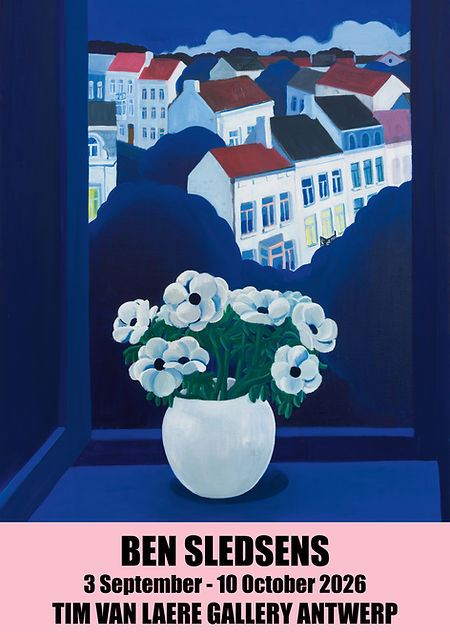
BEN SLEDSENS
An Apple for the Road
3 September - 10 October, 2026
In his solo exhibition, An Apple for the Road, Ben Sledsens presents a new series of paintings in which wonder, attentiveness, and imagination take center stage. The exhibition marks a subtle yet significant shift within his artistic practice. While his work remains immediately recognizable through its vibrant use of color, monumental compositions, and dreamlike imagery, this new body of work reveals a renewed search for spontaneity, freedom, and a conscious embrace of the naïve as an artistic strength.
This new series of paintings emerged mainly from an extensive group of works on paper that Sledsens has developed over the past several years as a freer and more intuitive counterpart to his paintings. Whereas a large canvas often requires a lengthy process of construction and refinement, paper offered the possibility of responding more quickly to ideas, observations, and associations. From these experiments grew new compositions, unexpected perspectives, and motifs that eventually found their way into the paintings. What initially began as a search for simplicity ultimately led to an expansion of his pictorial vocabulary. Close-up views of water lilies, rhythmic structures of reeds, floating flowers, an anthropomorphic cloud, and mystical landscapes introduce a greater sense of freedom into the compositions. Graphic rhythms and repetitions assume a more prominent role, while the paintings simultaneously retain a remarkable lightness.
At the heart of this new body of work lies a world of small, familiar experiences: a swan gliding across the water; a walk through a snow-covered landscape; a sailboat on a quiet sea; a bouquet of flowers beside an open window; an encounter with a frog, an owl, or a blooming water lily. These are not images of spectacular events, but rather moments in which time seems to briefly stand still. Water serves as an important anchor throughout the exhibition. Ponds, reflections, water lilies, and mirrored surfaces recur as places of tranquility, encounter, and contemplation. For Sledsens, water represents a universal attraction: a place where people, animals, light, and landscape converge. The water’s surface becomes a pictorial space in which color, reflection, and atmosphere continuously interact. Light also assumes a new role in this exhibition. In several works, the visible landscape seems to give way to something more fleeting and difficult to define. Mist, twilight, and reflections create atmospheric images in which forms dissolve and reappear. The artist seeks not only to depict a landscape but also to convey the experience of it: the humidity in the air, the disappearance of a horizon into snow, the flicker of light on water, or the almost tangible presence of silence. As a result, his paintings increasingly occupy the threshold between the recognizable and the elusive.
Although these works originate in observations drawn from everyday life, they are not literal records of reality. Sledsens constructs a world in which he himself would like to live; a personal universe where memories, impressions, desires, and echoes of art history converge. The paintings reveal not so much what the world looks like as how it can be felt, remembered, or dreamed. In this respect, his work aligns with a long art-historical tradition. Just as Claude Monet made the act of seeing his subject, and Pierre Bonnard fused memory and perception within intimate and deeply personal worlds, Sledsens builds a universe in which color, light, and emotion generate their own reality. At the same time, the mysterious quality of his imagery evokes associations with the Symbolists, for whom beauty was not merely an aesthetic quality but a gateway to imagination and inner experience.
At its core, the exhibition celebrates a profound belief in the power of beauty. In the contemporary art world aesthetics are often regarded with suspicion or dismissed as superficial, Sledsens however deliberately occupies a different position. For him, beauty is not simply a form of escapism but a way of looking more attentively at the world. It creates space for wonder, contemplation, and connection. This attitude echoes an idea that has resurfaced throughout the history of art. For Henri Matisse, art was a source of calm and mental clarity - a place where viewers could momentarily escape the turbulence of everyday life without turning away from reality. Beauty assumes a similar significance in Sledsens’s work. It is not just an escape from the world but a means of experiencing it anew. It is precisely in this regard that the exhibition finds its relevance. In an age defined by relentless streams of information, moving images, political tensions, digital acceleration, and constant visibility, these paintings create a rare space for attention. They invite viewers to slow down, to look longer, and to become receptive once again to what so often goes unnoticed. The aesthetic experience thus becomes more than visual pleasure alone; it becomes an invitation to encounter the world with renewed wonder.
With this exhibition, Ben Sledsens reveals an artistic practice in motion - one that remains faithful to its enduring fascination with nature, light, and beauty. These paintings remind us that meaning does not always reside in the extraordinary or the spectacular, but is often hidden within the small, the everyday, and the seemingly simple. It is precisely there, in this attentiveness to the fragile and the fleeting, that the distinctive power of his work unfolds.
In zijn nieuwe solotentoonstelling, An Apple for the Road, presenteert Ben Sledsens een reeks schilderijen waarin verwondering, aandacht en verbeelding centraal staan. De tentoonstelling markeert een subtiele maar betekenisvolle verschuiving binnen zijn oeuvre. Terwijl zijn werk steeds herkenbaar blijft door zijn uitgesproken kleurgebruik, monumentale composities en droomachtige beeldtaal, toont deze nieuwe reeks een hernieuwde zoektocht naar spontaniteit, vrijheid en een bewust omarmen van het naïeve als artistieke kracht.
Deze nieuwe reeks schilderijen ontstonden grotendeels vanuit een omvangrijke groep werken op papier die Sledsens de voorbije jaren ontwikkelde als een vrijere en meer intuïtieve tegenhanger van zijn schilderijen. Waar een groot doek vaak een langdurig proces van opbouw en uitwerking vraagt, bood papier de mogelijkheid om sneller te reageren op ideeën, observaties en associaties. Uit deze experimenten groeiden nieuwe composities, onverwachte perspectieven en motieven die vervolgens hun weg vonden naar de schilderijen. Wat aanvankelijk begon als een zoektocht naar eenvoud, leidde uiteindelijk tot een verruiming van zijn picturale vocabulaire. Ingezoomde waterlelies, ritmische structuren van riet, zwevende bloemen, een antropomorfe wolk en mystieke landschappen introduceren een grotere vrijheid in de composities. Grafische ritmes en herhalingen krijgen een prominentere plaats, terwijl de schilderijen tegelijkertijd een opmerkelijke lichtheid behouden.
Centraal in deze nieuwe reeks staat een wereld van kleine, herkenbare ervaringen. Een zwaan die voorbijglijdt over het water. Een wandeling door een besneeuwd landschap. Een zeilboot op een stille zee. Een boeket bloemen bij een open raam. Een ontmoeting met een kikker, een uil of een waterlelie in bloei. Het zijn beelden die geen spectaculaire gebeurtenissen tonen, maar momenten waarin de tijd even lijkt stil te vallen. Water vormt daarbij een belangrijk ankerpunt. Vijvers, reflecties, waterlelies en spiegelende oppervlakken keren terug als plaatsen van rust, ontmoeting en contemplatie. Voor Sledsens vertegenwoordigt water een universele aantrekkingskracht: een plek waar mens, dier, licht en landschap samenkomen. Het wateroppervlak wordt een picturale ruimte waarin kleur, reflectie en atmosfeer voortdurend met elkaar in dialoog treden. Ook het licht speelt een nieuwe rol in deze tentoonstelling. In verschillende werken lijkt het zichtbare landschap plaats te maken voor iets vluchtigers en moeilijker benoembaar. Mist, schemering en reflecties creëren atmosferische beelden waarin vormen oplossen en opnieuw verschijnen. De kunstenaar probeert niet enkel een landschap weer te geven, maar ook de ervaring ervan: de vochtigheid van de lucht, het verdwijnen van een horizon in sneeuw, het flikkeren van licht op water of de bijna tastbare aanwezigheid van stilte. Zijn schilderijen bewegen zich daardoor steeds vaker op de grens tussen het herkenbare en het ongrijpbare.
Hoewel de werken vertrekken vanuit observaties uit het dagelijkse leven, zijn het geen letterlijke registraties van de werkelijkheid. Sledsens construeert een wereld waarin hij zelf zou willen leven, een eigen universum waarin herinneringen, indrukken, verlangens en kunsthistorische echo's samenvloeien. De schilderijen tonen niet zozeer hoe de wereld eruitziet, maar hoe zij gevoeld, herinnerd of gedroomd kan worden. Daarmee sluit zijn werk aan bij een lange kunsthistorische traditie. Zoals Claude Monet het kijken zelf tot onderwerp maakte en Pierre Bonnard herinnering en waarneming liet samenvallen in intieme, persoonlijke werelden, bouwt Sledsens aan een universum waarin kleur, licht en emotie een eigen werkelijkheid creëren. Tegelijkertijd roept de mysterieuze kwaliteit van zijn beelden associaties op met de symbolisten, voor wie schoonheid niet louter een esthetische eigenschap was, maar een toegangspoort tot verbeelding en innerlijke ervaring.
Onderliggend aan de tentoonstelling ligt een uitgesproken geloof in de kracht van schoonheid. In een hedendaagse kunstcontext waarin esthetiek vaak met wantrouwen wordt bekeken of als oppervlakkig wordt beschouwd, kiest Sledsens bewust voor een andere positie. Voor hem is schoonheid niet enkel een vorm van escapisme, maar een manier om aandachtiger naar de wereld te kijken. Ze biedt ruimte voor verwondering, contemplatie en verbinding. Die houding sluit aan bij een gedachte die doorheen de kunstgeschiedenis steeds opnieuw opduikt. Voor Henri Matisse was kunst een bron van rust en mentale helderheid; een plek waar de toeschouwer even kon ontsnappen aan de onrust van het dagelijks leven zonder zich van de werkelijkheid af te keren. Ook bij Sledsens krijgt schoonheid die betekenis. Zij vormt geen vlucht uit de wereld, maar een manier om haar opnieuw te ervaren. Juist daarin schuilt de relevantie van deze tentoonstelling. In een tijdperk dat gekenmerkt wordt door voortdurende informatiestromen, bewegende beelden, politieke spanningen, digitale versnelling en permanente zichtbaarheid, creëren deze schilderijen een zeldzame vorm van aandacht. Ze nodigen uit om te vertragen, om langer te kijken en om opnieuw gevoelig te worden voor wat vaak onopgemerkt blijft. De esthetische ervaring wordt zo meer dan een visueel genoegen alleen. Ze worden een uitnodiging om de wereld opnieuw met verwondering tegemoet te treden.
Met deze tentoonstelling toont Ben Sledsens een oeuvre in beweging: trouw aan zijn fascinaties voor natuur, licht en schoonheid. De schilderijen herinneren ons eraan dat betekenis niet altijd schuilt in het uitzonderlijke of spectaculaire, maar vaak verborgen ligt in het kleine, het alledaagse en het ogenschijnlijk eenvoudige. Precies daar, in die aandacht voor het kwetsbare en het vluchtige, ontvouwt zich de bijzondere kracht van zijn werk.